Most websites fail to rank not because their content is weak, but because search engines do not fully trust them yet. This trust is built mostly outside your website. That is where off-page SEO comes in.
Off-page SEO is not about tricks or shortcuts. It is about signals that show your website is reliable, relevant, and worth ranking. These signals come from other websites, brands, platforms, and users across the web.
Many people misunderstand off-page SEO. Some think it only means backlinks. Others believe more links always mean better rankings. Both ideas are incomplete and often lead to poor results.
This guide is written for website owners, SEO professionals, and businesses who want clear, practical off-page SEO techniques that work in real situations. No theory. No outdated methods. Only approaches that help websites move up in search results in a safe and steady way.
What Is Off-Page SEO
Off-page SEO refers to all actions taken outside your website that help search engines judge its trust, authority, and relevance, such as backlinks, brand mentions, and external signals.
These signals help search engines decide:
- Whether your website is trustworthy
- Whether others on the web recognise your content
- Whether your site deserves higher rankings
What Off-Page SEO Really Means (In Simple Terms)
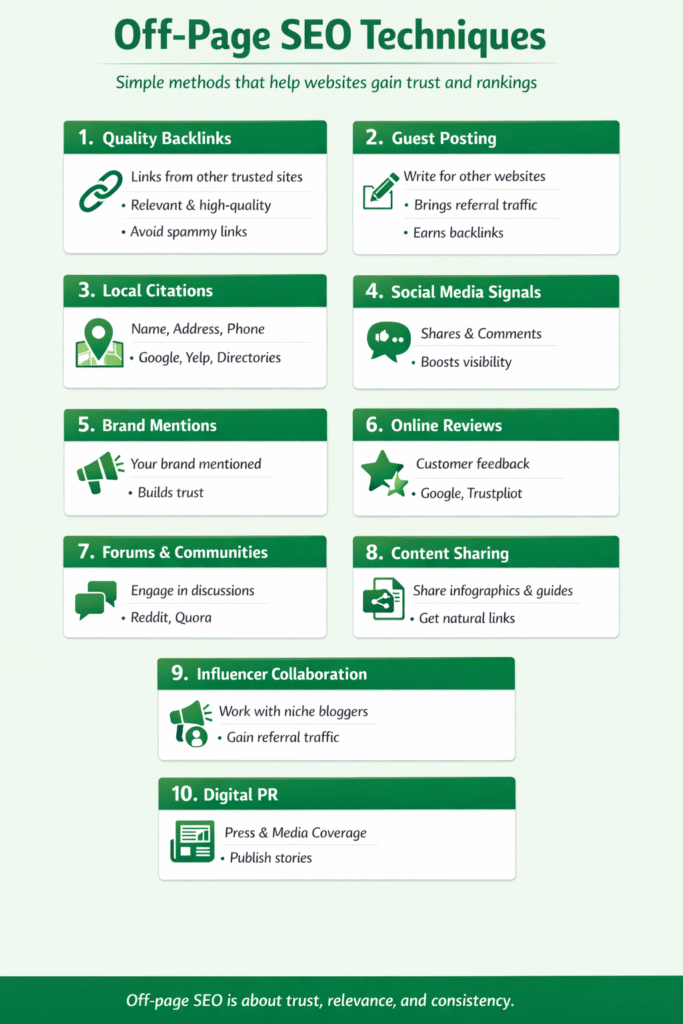
Off-page SEO is how the internet talks about your website.
It includes:
- Other websites linking to you
- Mentions of your brand or business name
- Reviews, citations, and references
- Visibility across trusted platforms
Why Rankings Depend on Signals Outside Your Website
Your website can be well-written and technically sound, but search engines still need proof that it matters.
External signals help search engines:
- Separate real businesses from low-quality sites
- Understand authority within a topic or industry
- Reduce manipulation and spam
In competitive searches, on-page SEO alone is rarely enough. Off-page signals often become the deciding factor.
Common Myths About Off-Page SEO
Many ranking problems come from believing the wrong things. Here are some common myths:
- More backlinks always mean better rankings
- Any link from a high-metric site is good
- Off-page SEO is risky by default
- Social media links directly increase rankings
- You can finish off-page SEO once and stop
These ideas usually lead to wasted time or penalties when followed blindly.
What This Guide Covers and Who It Is For
This guide explains:
- Off-page SEO techniques that still work today
- What search engines actually value
- What to avoid to protect your site
- How to build trust over time
It is written for:
- Business owners managing their own websites
- SEO professionals looking for clarity
- Content teams supporting SEO growth
- Anyone tired of outdated advice
What Is Off-Page SEO and Why Does It Matter
Off-page SEO is everything that happens outside your website that affects how search engines rank it.
It focuses on trust signals such as links, mentions, and references from other platforms across the web.
Definition of Off-Page SEO
Off-page SEO includes all external actions and signals that help search engines measure a website’s trust, authority, and relevance.
These signals do not come from your website itself. They come from how your site is mentioned, linked, and referenced elsewhere.
Common off-page signals include:
- Backlinks from other websites
- Brand mentions, linked or unlinked
- Reviews and citations
- Mentions on trusted platforms
Difference Between On-Page, Technical, and Off-Page SEO
Each SEO area plays a different role. None of them works well alone.
| SEO Type | What It Focuses On | Main Purpose |
| On-Page SEO | Content, headings, internal links | Helps search engines understand your pages |
| Technical SEO | Site speed, indexing, structure | Makes your site accessible and crawlable |
| Off-Page SEO | Links, mentions, trust signals | Proves your site is trusted and recognised |
On-page SEO tells search engines what your page is about.
Technical SEO ensures search engines can access it.
Off-page SEO decides whether it deserves to rank higher than others.
How Search Engines Judge Trust, Authority, and Relevance
Search engines rely on patterns, not promises. They look at how your website is treated by others.
They evaluate:
- Trust: Are reputable sites linking or referring to you
- Authority: Do authoritative sources in your niche mention you
- Relevance: Are the links and mentions related to your topic
A website linked by relevant, trusted sources is usually seen as safer and more reliable than one with no external validation.
Real Examples of Off-Page Signals Impacting Rankings
Off-page SEO directly affects rankings in practical ways:
- A service website gains links from local business directories and starts ranking in local searches
- A blog earns mentions from industry articles and moves above competitors
- An online store receives reviews and brand mentions, improving visibility for product-related searches
In competitive results, websites with similar content often rank differently.
The deciding factor is usually off-page signals.
How Google Evaluates Off-Page Signals
Google does not rank websites based on links alone. It looks at patterns, consistency, and context across the web. Off-page signals help Google judge whether a website is trusted by others or simply trying to look important.
Below is how these signals are evaluated in real ranking systems.
Authority vs Popularity
Authority and popularity are not the same thing, even though they often get mixed up.
- Popularity means many websites mention or link to you
- Authority means the right websites mention or link to you
A website with fewer links from respected industry sources often ranks higher than one with hundreds of random mentions. Google gives more weight to who is talking about you, not just how many are talking.
Quality Links vs Quantity
Google pays close attention to link quality.
A few strong links usually outperform many weak ones.
High-quality links usually come from:
- Websites related to your topic or industry
- Pages with real content and traffic
- Sources that link naturally, not in bulk
Low-quality links often come from:
- Spam sites
- Irrelevant blogs
- Automated directories
Google tracks link patterns over time. Too many low-value links can weaken trust instead of helping rankings.
Brand Mentions and Trust Signals
Not every mention needs to be a clickable link to matter.
Google also tracks:
- Brand name mentions
- Business name references
- Reviews and citations
- Mentions across trusted platforms
When a brand is mentioned naturally on relevant sites, it sends a trust signal. This helps Google understand that the website represents a real entity, not a temporary page made only to rank.
Relevance and Topical Alignment
Relevance is one of the strongest off-page signals.
Google checks:
- What topic does the linking site cover
- Whether the mention matches your niche
- How closely the content aligns
A single mention from a site in the same industry can be stronger than many mentions from unrelated websites. Topical alignment helps Google place your site correctly in search results.
Natural Growth vs Artificial Patterns
Google expects off-page signals to grow in a realistic way.
Natural patterns usually look like:
- Gradual link growth
- Mixed anchor text
- Mentions from different sources over time
Artificial patterns often include:
- Sudden spikes in links
- Repeated anchor text
- Links from similar or connected sites
When growth looks forced, trust drops. When growth looks natural, rankings tend to hold and improve steadily.
Key takeaway:
Google does not reward shortcuts. It rewards websites that earn attention naturally, over time, from relevant and trusted sources.
Share the next outline section, and I’ll continue writing in the same clear, structured format.
Link Building Techniques That Still Work
Link building still matters, but how links are earned matters more than ever. Google focuses on relevance, context, and natural placement rather than volume. Below are link-building approaches that continue to work because they align with how real websites link.
Editorial Backlinks
What they are
Editorial backlinks are links placed naturally within content because your page adds value. You do not request exact anchor text or placement. The site owner links because your content helps their readers.
Why they matter
These links carry strong trust signals because:
- They are earned, not forced
- They appear inside meaningful content
- They usually come from relevant pages
Search engines treat editorial links as genuine recommendations.
How to earn them naturally
- Publish content that solves a clear problem
- Share original data, examples, or explanations
- Create resources others can reference
- Promote content quietly to the right audience
When content is useful, links follow over time.
Guest Posting (Done the Right Way)
Guest posting still works when done with care and relevance. When done poorly, it becomes a risk.
How to choose the right websites
- Website covers the same or a related topic
- Real audience and consistent content
- Editorial standards are visible
- No obvious link-selling patterns
Avoid sites that publish anything for a fee.
Content standards to follow
- Write for the site’s audience, not search engines
- Provide practical value, not filler
- Match tone and depth of existing articles
- Avoid promotional language
Good guest content should stand on its own.
Anchor text best practices
- Use natural phrases
- Mix brand names, URLs, and generic terms
- Avoid repeated keyword anchors
Natural anchors reduce risk and improve trust.
What to avoid
- Exact-match anchors in every post
- Low-quality publishing networks
- Duplicate or thin content
- Over-optimised author bios
Niche-Relevant Backlinks
Why relevance matters more than metrics
A relevant link from a smaller website often helps more than a strong link from an unrelated one. Google prioritises topic alignment over raw authority numbers.
Where niche-relevant links come from
- Industry blogs
- Educational resources
- Tools and guides
- Community websites
These links help Google understand what your site represents.
Local and regional relevance
For service-based or local businesses:
- Local blogs
- Business associations
- Chambers of commerce
- Local news features
These signals support visibility in location-based searches.
Contextual Links vs Profile Links
The difference is explained simply
- Contextual links appear within real content
- Profile links sit in author bios, comments, or user pages
Contextual links are part of the discussion. Profile links are usually background signals.
| Link Type | Placement | SEO Value |
| Contextual | Inside content | High |
| Profile | Bios or profiles | Low to moderate |
Which ones help more, and why
Contextual links help more because:
- They are surrounded by relevant text
- They show editorial intent
- They pass stronger trust signals
Profile links can support visibility, but should never be the main strategy.
Brand Mentions and Authority Signals
Not every trust signal comes in the form of a backlink. Search engines also pay attention to how often and where your brand is mentioned, even when no link is present. These signals help confirm that a website represents a real, recognised entity.
What Unlinked Brand Mentions Are
An unlinked brand mention happens when:
- Your business name is mentioned
- Your website is referenced in text
- No clickable link is added
For example, a blog may mention your company name while discussing a topic, without linking to your site. Search engines can still read and understand this reference.
How Brand Mentions Help SEO
Brand mentions support SEO by strengthening trust signals.
They help search engines:
- Confirm brand authenticity
- Understand business legitimacy
- Connect brand names with topics
- Reduce reliance on links alone
When a brand is mentioned repeatedly across relevant sources, it sends a strong authority signal, even if some mentions are unlinked.
Where Brand Mentions Usually Come From
Natural brand mentions often appear on:
- Industry blogs and articles
- Reviews and comparison posts
- Business directories
- News sites and features
- Forums and community discussions
These mentions usually happen when a brand becomes part of ongoing conversations within a niche.
How to Encourage Natural Brand Mentions
Brand mentions grow when a business is visible and useful.
Effective ways include:
- Publishing original, helpful content
- Offering expert insights or quotes
- Being active in industry discussions
- Providing services worth talking about
Mentions happen naturally when people refer to your brand as a resource, not when they are asked to promote it.
Digital PR for Off-Page SEO
Digital PR focuses on earning visibility through credibility, not pushing links. When done correctly, it strengthens off-page SEO by placing your brand in trusted publications and expert-driven content that search engines already respect.
What Digital PR Means in SEO
In SEO, digital PR means:
- Getting featured on trusted websites
- Being cited as an expert source
- Earning mentions from authoritative publications
The goal is not link volume. The goal is recognition from reliable sources that signal trust and expertise.
Press Features vs Spam Press Releases
There is a clear difference between real press coverage and mass-distributed releases.
Real press features:
- Written by journalists or editors
- Published on trusted news or industry sites
- Mention brands naturally within stories
- Often includes expert quotes or data
Spam-style press releases:
- Syndicated across low-quality networks
- Repetitive and promotional
- Created mainly for links
- Provides little real value
Search engines value editorial coverage, not bulk distribution.
HARO-Style Platforms Explained
HARO-style platforms connect journalists with experts.
They work by:
- Journalists posting questions
- Experts submitting short, helpful answers
- Selected responses are being published with mentions
These platforms help earn:
- High-trust brand mentions
- Editorial backlinks
- Industry recognition
Responses must be clear, relevant, and genuinely helpful to be chosen.
How Expert Quotes Help Rankings
Expert quotes strengthen off-page SEO in subtle but powerful ways.
They:
- Position your brand as knowledgeable
- Build topical authority
- Generate trusted mentions
- Support long-term ranking stability
When your insights appear across reputable sources, search engines associate your brand with expertise in that subject area.
Local Off-Page SEO Techniques
Local off-page SEO helps search engines confirm where your business operates and how trusted it is in that area. These signals strongly influence visibility in map results and location-based searches.
Google Business Profile Signals
A Google Business Profile is one of the strongest local off-page signals.
Search engines look at:
- Profile completeness
- Business category accuracy
- Regular updates and posts
- Photos and real activity
An active, accurate profile helps confirm that a business is legitimate and serving customers in a specific location.
Local Citations and Consistency
Local citations are mentions of your business details across the web.
They usually include:
- Business name
- Address
- Phone number
Consistency matters more than volume. When details match across platforms, search engines gain confidence in the business information.
Common citation sources include:
- Business directories
- Local listing platforms
- Industry-specific directories
Local Backlinks from Real Businesses
Local backlinks strengthen geographic relevance.
Strong local link sources include:
- Nearby businesses
- Local blogs
- Community organisations
- Event or sponsorship pages
These links signal that the business is connected to the local community, not just targeting keywords.
Reviews and Reputation Signals
Reviews influence both rankings and user decisions.
Search engines consider:
- Review quantity and freshness
- Review diversity across platforms
- Natural language in reviews
Regular, genuine reviews help build trust and improve local visibility over time.
Social Signals and Their Indirect Impact
Social media does not directly control rankings, but it supports off-page SEO in indirect and practical ways. Its real value comes from visibility, discovery, and amplification rather than link strength.
Do Social Links Help SEO?
Social media links are usually marked as no-follow, which means they do not pass traditional link value.
However, they still help by:
- Driving real users to your content
- Helping content get noticed
- Supporting brand recognition
Social links act as distribution channels, not ranking shortcuts.
How Content Sharing Increases Reach
When content is shared on social platforms:
- More people see it
- Journalists and bloggers may discover it
- Industry professionals engage with it
This exposure increases the chance that your content earns natural links and mentions from other websites.
Relationship Between Visibility and Backlinks
Most backlinks start with visibility.
The typical flow looks like this:
- Content is shared on social platforms
- Relevant users find it
- Content is referenced or linked on blogs or articles
Social activity does not replace link building, but it supports the process that leads to links.
Platforms That Matter Most by Industry
Different platforms work better for different niches.
| Industry Type | Platforms That Matter |
| B2B | LinkedIn, X |
| E-commerce | Instagram, Pinterest |
| Local services | Facebook, Google Business |
| Media and blogs | X, Reddit |
The goal is not to be everywhere. It is to be visible where your audience already is.
Content-Driven Off-Page SEO
Off-page SEO works best when content gives people a reason to reference it. Links, mentions, and shares usually happen because content solves a problem, not because it exists.
Linkable Content Types
Some content formats attract links more naturally than others.
Common linkable formats include:
- In-depth guides
- Research-backed articles
- Industry comparisons
- Educational resources
These formats give other websites something worth pointing their readers to.
Data-Based Content
Original data increases credibility.
This includes:
- Surveys and studies
- Industry statistics
- Market trends
- Case summaries
Websites often link to data to support their own content, making data-driven pages strong link assets.
Guides, Checklists, and Tools
Practical content gets referenced more often.
Examples include:
- Step-by-step guides
- Actionable checklists
- Calculators or simple tools
These resources save time for readers and are often reused by bloggers and professionals.
Why Shallow Content Fails to Attract Links
Content that repeats basic information rarely earns attention.
Shallow content usually:
- Lacks original insight
- Adds no practical value
- Offers nothing new to reference
Without depth or usefulness, there is no reason for others to link to or mention it.
Broken Link Building Explained Simply
A practical way to earn relevant links
Broken link building works because it helps both sides. You help website owners fix broken pages, and in return, they may reference your content as a replacement.
What Broken Links Are
A broken link is a link that points to a page that no longer exists.
This usually happens when:
- A page is deleted
- A website structure changes
- A domain expires
Broken links create a poor user experience, which most site owners want to fix.
Why Site Owners Replace Broken Links
Website owners care about:
- User experience
- Content quality
- Site credibility
Replacing broken links:
- Improves usability
- Prevents lost traffic
- Maintains trust
When you offer a relevant replacement, it saves them time.
Step-by-Step Outreach Logic
Broken link outreach follows a simple process:
- Find a page with broken outbound links
- Identify the missing content topic
- Create or match a relevant replacement page
- Inform the site owner politely
- Suggest your content as an option
The focus should be on helping, not pushing.
Common Mistakes
Broken link building fails when done incorrectly.
Common errors include:
- Offering irrelevant content
- Sending generic outreach emails
- Mass messaging without context
- Asking directly for links
Personalised and helpful outreach works far better than volume.
Competitor Backlink Analysis
Competitor backlink analysis helps you understand why other websites rank above you. It shows where trust is coming from and which signals search engines are responding to.
Why Competitor Links Matter
Competitor links reveal what search engines already trust.
They help you:
- Identify authoritative sources in your niche
- Understand link expectations for your topic
- See which content attracts references
If multiple competitors earn links from the same type of sites, those sources likely matter.
What to Copy and What to Ignore
Not every competitor link is worth following.
Worth copying:
- Editorial links from relevant blogs
- Mentions from industry resources
- References tied to useful content
Better to ignore:
- Paid or spam-style links
- Irrelevant directory listings
- Links with forced anchor text
The goal is to learn, not to replicate mistakes.
How to Spot Patterns
Patterns reveal what works consistently.
Look for:
- Repeated link sources across competitors
- Similar content formats earn links
- Common topics that attract attention
When patterns appear, they usually point to opportunities worth exploring.
Using Insights to Plan Outreach
Competitor analysis should guide outreach strategy.
Use insights to:
- Create better versions of linked content
- Identify websites open to references
- Tailor outreach messages with context
Outreach becomes more effective when based on proven link behaviour, not assumptions.
Anchor Text Strategy for Off-Page SEO
Anchor text tells search engines what a linked page is about. When used naturally, it supports relevance. When forced, it creates risk. A balanced approach is essential for stable rankings.
Types of Anchor Text
Anchor text appears in different forms, each serving a purpose.
Common types include:
- Branded: business or website name
- Generic: words like “this site” or “here”
- URL-based: raw website address
- Partial-match: includes part of a topic phrase
- Descriptive: explains content naturally
Using one type repeatedly creates an imbalance.
Natural vs Forced Usage
Natural anchor text:
- Fits smoothly into the sentence
- Matches how people normally write
- Varies across different links
Forced anchor text:
- Repeats exact phrases
- Feels promotional
- Breaks sentence flow
Search engines are designed to detect unnatural repetition.
Over-Optimization Risks
Over-optimisation happens when anchors are too controlled.
Common warning signs include:
- Too many exact-match anchors
- Identical anchors from multiple sites
- Sudden changes in anchor patterns
These signals can reduce trust and limit ranking growth.
Safe Anchor Mix Examples
A healthy anchor profile looks varied.
Example mix:
- Brand name mentions
- Descriptive phrases
- Natural sentence-based anchors
- Occasional topic references
The focus should be readability first, optimisation second.
Toxic Backlinks and What to Avoid
Not every backlink helps. Some links reduce trust and slow ranking growth. Understanding which links are harmful helps protect your website from long-term damage.
What Harmful Backlinks Look Like
Toxic backlinks usually show clear warning signs.
They often come from:
- Websites with no real content
- Pages filled with unrelated outbound links
- Auto-generated or spun articles
- Sites created only to link out
These links add no real value and signal manipulation.
Common Sources of Bad Links
Harmful links often appear from:
- Low-quality directories
- Link farms and networks
- Spam blog comments
- Random foreign-language sites
These sources exist to sell or trade links, not to help users.
Paid Links and Networks
Buying links carries risk.
Paid link patterns usually include:
- Identical anchor text
- Links are laced across multiple sites at once
- Content written only to host links
Search engines actively target link networks because they distort trust signals.
When Disavow Is Needed and When It Is Not
Disavow should be used carefully.
Disavow may be needed when:
- Links are clearly spam-based
- Manual actions are involved
- Large-scale toxic patterns exist
Disavow is usually not needed when:
- Links are low quality but natural
- No penalties are present
- The site has a healthy link profile
In most cases, ignoring weak links is safer than reacting aggressively.
Off-Page SEO for New Websites
New websites face different challenges than established ones. Search engines have little data to judge trust, so off-page SEO must focus on credibility building, not fast results.
Challenges New Sites Face
New websites usually struggle because:
- No backlink history exists
- Brand is unknown
- Few external references are available
- Trust signals take time to develop
This makes early rankings slower, even with good content.
Realistic Expectations
Off-page SEO does not work instantly for new sites.
What to expect:
- First 1–2 months: discovery and crawling
- Months 2–3: early mentions and low-level links
- After 3 months: gradual movement, not jumps
Progress is slow at first, but it becomes more stable over time.
First 90-Day Off-Page Plan
A simple and safe starting plan:
Days 1–30
- Set up business profiles and citations
- Secure basic brand mentions
- Publish link-worthy core content
Days 31–60
- Start outreach to relevant blogs
- Engage in industry communities
- Share content for visibility
Days 61–90
- Earn first editorial or niche links
- Track link growth patterns
- Refine outreach based on responses
The goal is consistency, not volume.
Focus Areas for Beginners
New sites should focus on:
- Relevance over authority metrics
- Brand mentions over exact anchors
- Content quality over promotion
- Natural growth over shortcuts
These foundations protect rankings as the site grows.
Off-Page SEO Mistakes That Hold Sites Back
Many websites fail to see results from off-page SEO, not because they do nothing, but because they focus on the wrong things. Avoiding these mistakes is often more important than adding new links.
Chasing Metrics Only
Metrics like Domain Authority or traffic estimates are helpful, but they are not ranking factors.
Problems arise when:
- Links are chosen only by numbers
- Relevance is ignored
- Real audience value is overlooked
A smaller, relevant site can provide more value than a large but unrelated one.
Irrelevant Backlinks
Relevance is a core trust signal.
Irrelevant links:
- Confuse search engines
- Add no topical value
- Can weaken authority over time
Links should come from websites that make sense for your topic or location.
Overuse of Exact Anchors
Repeating the same keyword anchors creates risk.
This often leads to:
- Unnatural link patterns
- Reduced trust
- Ranking stagnation
Natural language anchors protect long-term visibility.
Inconsistent Efforts
Off-page SEO is not a one-time task.
Inconsistent patterns include:
- Long gaps between link activity
- Sudden bursts followed by silence
- No ongoing brand presence
Search engines trust steady, natural growth more than irregular spikes.
Off-Page SEO Checklist (Quick Reference)
Use this checklist to quickly review whether your off-page SEO efforts are aligned with what search engines trust.
Link Quality Check
- Links come from real, active websites
- Pages contain relevant content
- Links are placed naturally within text
- No obvious spam or automation patterns
Relevance Check
- Linking sites match your industry or topic
- Local links match your service area
- Content around the link is contextually related
- No random or unrelated placements
Brand Signals Check
- Brand name appears across trusted platforms
- Mentions occur naturally, not forced
- Reviews are present and recent
- Business details are consistent
Outreach Consistency Check
- Outreach is ongoing, not one-time
- Messages are personalised
- Content promotion is steady
- Growth patterns look natural
Conclusion
Off-page SEO is not about finding shortcuts. It is about earning trust across the web. Search engines reward websites that are mentioned, referenced, and linked because they are useful, not because they push links.
Consistency matters more than volume. A steady flow of relevant mentions, links, and visibility builds stronger signals than sudden spikes that disappear just as fast.
Long-term thinking always wins. Websites that focus on relevance, quality, and natural growth protect their rankings and continue to improve over time.
FAQs (For Rich Results & AEO)
How long does off-page SEO take to work
Off-page SEO usually shows early signs within 2 to 3 months, but strong and stable results take longer. Trust builds gradually as links, mentions, and brand signals grow naturally over time.
Are backlinks still important
Yes, backlinks are still important. They remain one of the strongest trust signals. However, quality and relevance matter more than quantity, and links work best when combined with strong content.
How many backlinks does a website need
There is no fixed number. A website needs enough relevant and trusted links to compete with others in the same search results. In many cases, a few strong links outperform hundreds of weak ones.
Can off-page SEO work without content
Off-page SEO depends on content. Without useful content, there is nothing for others to link to or mention. Even service websites need clear, helpful pages to support off-page efforts.
Is off-page SEO safe for small businesses
Yes, off-page SEO is safe for small businesses when done correctly. Focusing on relevance, local signals, brand mentions, and steady growth reduces risk and supports long-term visibility.